Executive Summary:
The paper asks: How often does Israeli electoral propaganda invoke the image of the enemy in the first election after October 7, and who is this enemy for each of the two main camps? It answers by analyzing 270 posts published by the official accounts of Benjamin Netanyahu’s camp (127 posts) and Gadi Eisenkot’s camp (143 posts) on Instagram between August 5 and September 4, 2026.
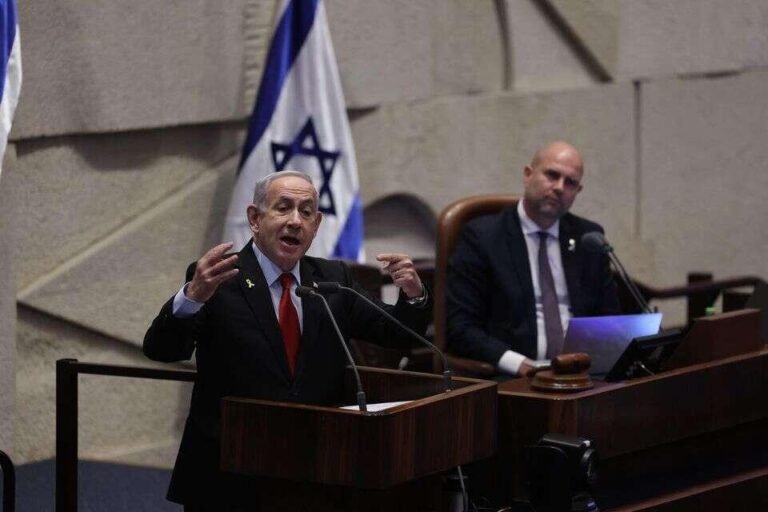
Netanyahu’s camp invokes an external or ethnic enemy in 34.6% of its posts, compared with 6.3% for Eisenkot, that is, more than five times as much. The primary enemy in Netanyahu’s discourse is the Arab parties and Mansour Abbas (22% of his posts), exceeding Iran, Hezbollah, Gaza, and Turkey combined, while Erdoğan, Mamdani, and Naim Qassem appear in images and sketches and rarely in the text. Eisenkot’s hostility, by contrast, is directed inward: Netanyahu and the “October 7 Cabinet,” as accountability and the official commission of inquiry occupy 30.8% of his posts, and the Arab parties are not mentioned in any of them.
Netanyahu needs the enemy because his security record collapsed on October 7, so he shifts the question of the ballot from “What have you done?” to “Who protects us?” His choice falls specifically on the Arab citizen because the change camp does not have a majority without the Arab parties or their abstention. Eisenkot completely avoids the axis of right and left because it is his opponent’s playing field, and he fights the battle on competence and accountability. Beneath the language of national unity in the two campaigns lies a class dispute over who pays the cost of the war, reservists or the Haredim exempt from conscription, and the Arab enemy helps keep it outside the debate.
From here, it can be said that the two camps differ over the management of the post-October 7 phase, and converge on the Arab’s place in the political community: Netanyahu raises him as a scarecrow, while Eisenkot drops him from speech. What the ballot boxes of October 27 decide is the identity of who manages the project; as for its boundaries, the two campaigns decided them during the weeks of propaganda.
The Question and the Hypothesis
The Israeli elections will take place on October 27, 20261, the first since October 7. In a campaign in which the ballot is presented as a “shield against an existential danger,” the enemy becomes a key to understanding the way propaganda persuades its voter. From here, the paper poses two questions: How often is the image of the enemy—the Arab, Palestinian, and regional enemy—invoked in electoral discourse? And who precisely is this enemy for each camp?
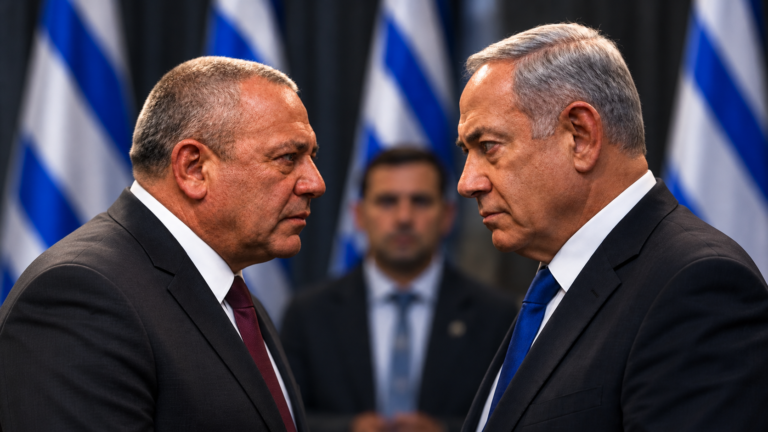
To answer, the paper compares the two poles of competition: Benjamin Netanyahu (Likud) and Gadi Eisenkot (Yashar). The value of the comparison lies in the fact that the two campaigns address the same public at the same time, and each leans on a weighty military and security record, yet they differ in the identity of the enemy from whom they frighten the public.
The paper began from a hypothesis formed while following the campaign: Netanyahu’s discourse is based on invoking the Arab and Islamic side, from Mansour Abbas to Erdoğan, Naim Qassem, and Zohran Mamdani, as compensation for a security record that collapsed on the morning of October 7, while his opponent builds his message precisely on that failure. The results fully confirmed the second part of the hypothesis, and amended the first part on an essential point: the central enemy for Netanyahu is the Arab citizen inside Israel and his parties represented in The Knesset; as for regional figures, they play a less frequent, performative visual role.
The second section presents the method and sample, and the third the quantitative results. The fourth and fifth sections deconstruct the structure of the enemy for each camp, while the sixth proposes an explanation for this distribution; the conclusion then returns to the two questions to answer them.
Method and Sample
The sample consists of posts from the four official Instagram accounts: b.netanyahu and likud_party for Netanyahu’s camp, and gadi_eisenkot and yasharwitheisenkot for Eisenkot’s camp, over 31 days from August 5 to September 4, 2026, that is, from the eighty-third day to the fifty-third day before the vote. Their total was 270 posts: 127 for Netanyahu’s camp and 143 for Eisenkot’s camp2, and a post shared between the personal and party accounts was counted once.
The unit of analysis is the post, with its accompanying text and its visual element when readable. Each post was coded using multi-category coding according to a guide of 15 categories, to which a composite indicator was added that brings together all forms of the external and ethnic enemy. Facebook pages were excluded because they automatically republish Instagram content, and dozens of posts in the sample carry the cross-posting tag, so Instagram alone was adopted to prevent double counting. This in itself is a datum: the propaganda structure of the two camps is unified across “Meta” platforms.
The sample has three limits. The first is that the coding relied primarily on texts. The second is that videos with brief captions, such as “important update,” may contain hostile content that was not counted; therefore the figures represent a lower bound. The third is that the sample does not include paid advertisements that do not appear on the accounts.
Results
| Category | Netanyahu/Likud (127 posts) | Eisenkot/Yashar (143 posts) |
|---|---|---|
| Arab parties / Mansour Abbas | 28 (22.0%) | 0 (0%) |
| Ethno-political delegitimization of the opponent (a left-wing government with the Arab parties) | 37 (29.1%) | 0 (0%) |
| Performance-based delegitimization of the opponent (the evasion government, the 7.10 Cabinet, surrendered and fled) | 3 (2.4%) | 18 (12.6%) |
| Invoking “Israel’s enemies” for mobilization | 9 (7.1%) | 1 (0.7%) |
| Iran / Hezbollah | 9 (7.1%) | 4 (2.8%) |
| The Palestinian state / the Authority as a threat | 6 (4.7%) | 1 (0.7%) |
| Gaza / Hamas | 4 (3.1%) | 3 (2.1%) |
| Turkey / Erdoğan (text or image) | 5 (3.9%) | 0 (0%) |
| October 7 (the event) | 2 (1.6%) | 18 (12.6%) |
| The media (as adversary or platform) | 7 (5.5%) | 1 (0.7%) |
| Accountability / official commission of inquiry | 0 (0%) | 44 (30.8%) |
| Conscription of the Haredim / evasion | 0 (0%) | 13 (9.1%) |
| Civil issues (education, crime, cost of living, the north) | 4 (3.1%) | 47 (32.9%) |
| Mobilization, personal content, and occasions | 52 (40.9%) | 52 (36.4%) |
| War and diplomatic achievements | 12 (9.4%) | 1 (0.7%) |
| Composite indicator: external or ethnic enemy (Arabs, Palestinians, Iran, Turkey, Gaza, enemies) | 44 (34.6%) | 9 (6.3%) |
The table reveals, first, the size of the gap: more than a third of Netanyahu’s posts (34.6%) invoke an external or ethnic enemy, compared with 6.3% for Eisenkot. Second, it reveals the identity of the enemy: the largest single category in Netanyahu’s discourse is the Arab parties and Mansour Abbas (22%), ahead of Iran, Gaza, and Turkey combined.
Third, what is striking is the absence of the event that is supposed to frame these elections. October 7 appears in only two posts out of 127 for Netanyahu, one of them explicitly defensive (“You asked: Why didn’t they wake me on October 7?”), while it appears in 12.6% of Eisenkot’s posts, coupled with accountability, which occupies 30.8% of his campaign.
Fourth, both camps practice delegitimization of the opponent, but they differ in its type. For Netanyahu, it is ethno-political delegitimization that attaches the opponent to Arabs, the left, and the enemy (29.1%); for Eisenkot, it is performance-based delegitimization built on ready-made labels such as “the evasion government,” “the 7.10 Cabinet,” and “the worst government in history” (12.6%). In other words, each camp speaks extensively about what its opponent avoids: Netanyahu about the enemy, and Eisenkot about October 7.
Netanyahu’s Enemy: Three Overlapping Rings
The enemy in Netanyahu’s campaign operates on three rings that differ in channel, frequency, and function: a daily textual ring centered on the Arab parties, a performative visual ring centered on regional figures, and an internal ring centered on the media.
The Daily Ring: The Arab Parties as the Campaign’s Engine
Netanyahu’s digital campaign is built on one sentence repeated in nearly literal formulas: “There is no Eisenkot government without Yair Golan and the Arab parties.” This formula and its variations, with the addition of Lieberman or by naming Mansour Abbas, appeared in 24 posts over 31 days, that is, at a rate of nearly one post per day, reaching five times on the peak day (August 26). Mansour Abbas is mentioned by name in 11 posts, while the current Israeli defense minister was not mentioned in any text in the sample. Among 37 posts using the frame of the “left-wing government,” 24 posts (64.9%) explicitly pair the left with the Arab parties, until the two words in this discourse became practically synonymous.
This discourse operates through a chain of equivalence that expands ring after ring: Eisenkot equals Lieberman, equals Yair Golan, equals Mansour Abbas, then Tibi and Balad, then the “Muslim Brotherhood,” then the Palestinian state, and finally Iran. The August 28 post, addressed to Ben-Gvir, brings the entire chain together in one text: an Eisenkot government “will establish a Palestinian state,” “will evacuate your home, Itamar,” and “will shut down Channel 14,” in contrast to a government that “saved Israel from Iranian nuclear extermination.” The August 22 post tightens the construction: “A Palestinian state ruled by Iran will not be established… the price of the left’s coalition with the Muslim Brotherhood.”3
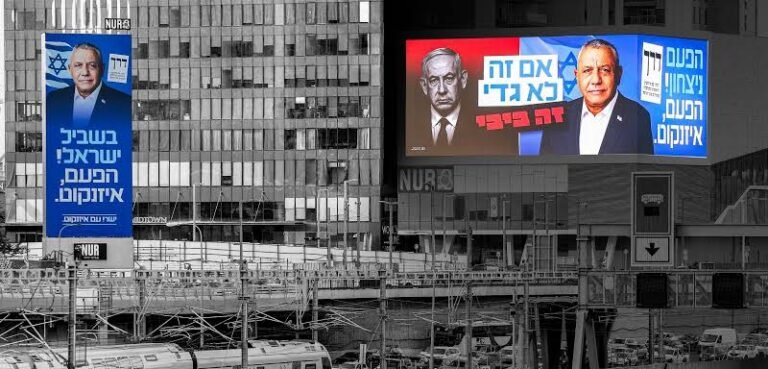
Through this chain, Arab citizens, who are one-fifth of the state’s citizens and have parties represented in The Knesset, are transformed from a legitimate political actor into an arm of an external enemy, and the Jewish opponent is expelled from the community merely by being attached to them. The image of Lieberman embracing Abbas (August 27) and the hashtag “Trojan horse” (August 26) visually summarize this logic. The chain is accompanied by a less frequent and higher-pitched line (3 posts) that describes Eisenkot as having “surrendered and fled the cabinet before the pager operation” and “raised a white flag.” The target here is specifically the general’s military record, because it is his basic electoral asset.
The Performative Ring: Erdoğan, Mamdani, and Qassem
Regional figures are more present than the texts suggest, but they pass through the image. Erdoğan appears five times: once textually, in a warning about Turkish positioning in Syria (“We made the message clear: Don’t”), and four times visually, in a clip of one of his speeches translated into Hebrew, a poster saying “they want Netanyahu to lose,” an AI-generated sketch pinned on the Likud account in which an actor playing Mamdani phones him, and a slide bearing the Turkish flag. As for Mamdani, his name does not appear in any text, and he appears visually at least three times.
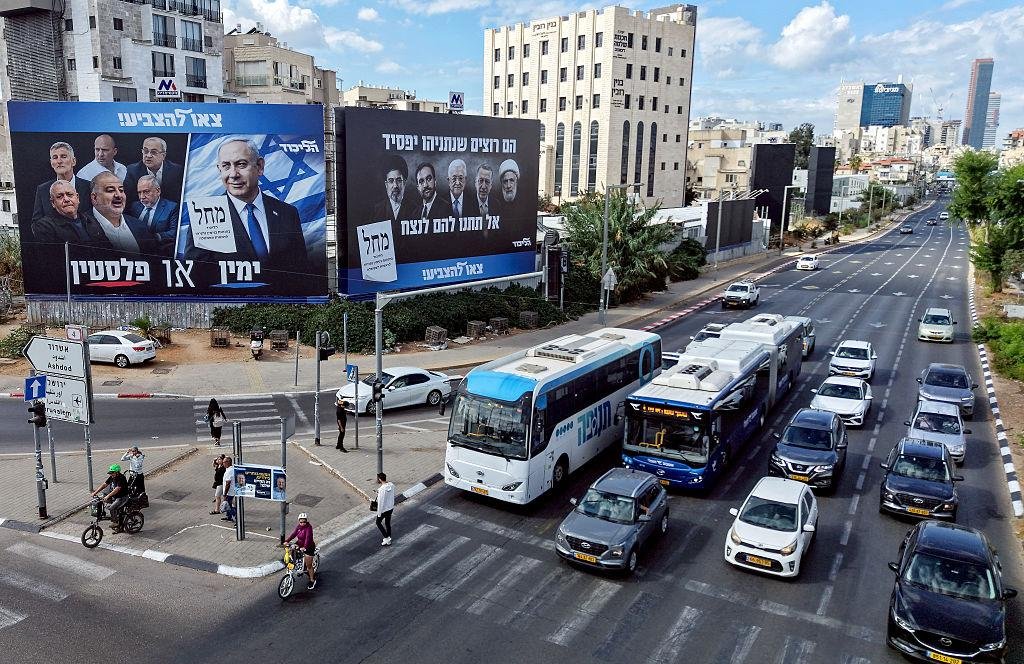
This ring reaches its peak in the August 30 carousel: seven slides bringing together the gallery of enemies under the slogan “Israel’s enemies must not be allowed to win,” including Mahmoud Abbas in letters made from the Palestinian flag, a tweet about the Palestinian Authority’s pressure to unify the Front, the Arab Movement for Change, and Balad against Netanyahu, Erdoğan with the Turkish flag, Mamdani, Mojtaba Khamenei in the colors of the Iranian flag, and Naim Qassem beside a pager device. The road billboard documented by Haaretz on August 16, featuring Mamdani, Khamenei, Erdoğan, and Qassem,4 is a street extension of the same digital chain.
This reveals a division of labor between text and image. Daily textual repetition is reserved for the Arab parties (28 posts), while the regional figures are managed through images and sketches within the discourse of Israel’s enemies (9 posts), where the face does not need a sentence. The image produces surprise and circulation, even as it invokes an American mayor who leads Netanyahu in the eyes of U.S. Jews (44% positive views compared with 32%, according to an AP-NORC survey)5. The text daily consolidates the closest enemy and the easiest for the base to believe. Erdoğan is not running for The Knesset, whereas Mansour Abbas may sit in its coalition, and this is the difference between an enemy suitable for a poster and an enemy suitable for the ballot box.
The phrase “Israel’s enemies” appeared in its general form in 9 posts (7.1%), including a Likud tweet about Arab states that want to topple Netanyahu so that Eisenkot and Golan will give them everything they want, and another celebrating an article in the official Iranian news agency that wishes for his fall. This elastic frame performs two functions: it turns the elections from internal accountability into an existential battle, and places everyone who wants to change the government, including Israeli voters, in the category of the enemy objectively. The dominant formula merges the man with the state: Israel’s enemies want Netanyahu to fall. By contrast, the word “enemies” appeared once in Yashar’s 143 posts, and with an opposite logic: a quote from party candidate Shaul Meridor saying that the prosperity of the north will be the victory over our enemies. For Netanyahu, enemies are an argument for his remaining in power; for his opponent, defeating them is the result of the government’s work.
The Internal Ring: The Media
The third ring is internal and targets the media: “The media lies, these are the facts” (September 3), then “even at Haaretz they know” when the newspaper says what serves the campaign. Channel 14 appears in the sample as a preferred platform for the campaign (two invitations to watch on August 30 and 31), the channel that the Seventh Eye’s Representation Index found excludes Arabs from its screen almost completely. That is, the platform from which the campaign addresses its base is already devoid of the category from which it constructs the image of the enemy, so the viewer finds nothing to disturb the narrative.
Eisenkot’s Enemy: Netanyahu Himself
Accountability in Place of the Enemy
The structure of Eisenkot’s campaign is inverted. Its first enemy is internal and named: Netanyahu and the October 7 Cabinet. The category of accountability, including opening the protocols of the war cabinet, forming an official commission of inquiry, and assigning responsibility, covers 30.8% of his posts; October 7 appears in 12.6% of them with phrases such as “no betrayal and no failure: blindness and criminal negligence” and “either victory on 27.10 or a second 7.10.” Delegitimization for him is purely performance-based, with a ready-made lexicon that fills 18 posts: the evasion government, the failure government, the 7.10 Cabinet, the worst government in history, the TikTok minister, and a party of which only the name remains.
Eisenkot approaches the logic of attaching someone to the enemy only once, in a post that pairs Netanyahu with Yahya Sinwar (“when Netanyahu and Sinwar spoke between them”) in a reference to the channel of understandings with Hamas, compared with 24 posts by Netanyahu that attach his opponent to the Arab parties. When he invokes an external enemy (6.3% of his posts), he usually places it in the context of competence: there is no real security in the north without disarming southern Lebanon and dismantling Hezbollah, and under the rule of this government Iran is closer than ever to a nuclear weapon. The Arab parties are not mentioned in any post
The Absence of the Word Left
In the lexicon, there is a gap more telling than the numbers. The word “left” does not appear in any of the 143 posts of Eisenkot’s camp, whether in attack or defense, while Netanyahu builds 29.1% of his discourse on it. The absence here is a deliberate choice: entering into a right-left polemic means playing on the opponent’s field, so Eisenkot replaces it with two axes on which he has the advantage: the Zionist versus the service evader, and the successful versus the failed. His party’s account contents itself, in responding to the daily bombardment, with quoting Mariah Carey’s song: “Why are you so obsessed with me?”. Even his recurring war slogan, “Israel must win,” promises victory without naming the defeated, because naming returns the campaign to the field it was designed to leave.
The Limits of the Alternative
A measure of critical distance is necessary here. Eisenkot’s refraining from demonizing the Arab parties is a refraining from a propaganda tool, and does not rise to the level of political recognition of them. His campaign promises an “official Zionist government” and explicitly courts “frustrated Likudniks,” although he launched it pledging to be “prime minister for all Israelis”6. The Arab appears in it only in the form of conditional individual integration: a Druze candidate who is a former general, and one post about “Jewish and Arab” volunteers in Jerusalem; he is entirely absent as a collective political partner. Thus, both camps place the Palestinian outside the boundaries of the political community in advance: one raises him as a scarecrow, and the other drops him from speech. The noisy disagreement between them revolves around the management of the project, while the question of the “citizen” in whose name the two campaigns speak remains entirely outside the debate.
Explaining the Distribution
The preceding figures describe what the two campaigns say. This section proposes three complementary explanations for why they say it.
The Enemy as a Substitute for the Record
Netanyahu’s political image was built on security competence, and this image was shattered on the day Israel was attacked while he was head of government. Therefore, any discussion of his record opens the file of October 7. Invoking the enemy shifts the question of the ballot from “What have you done?” to “Who protects us?”, that is, from a past open to accountability to a future open to fearmongering. The internal enemy is less costly and has a longer shelf life than any external enemy with whom Netanyahu himself, or whoever succeeds him, may one day sign an agreement.
Coalition Calculations
The focus of the attack on the Arab parties reflects a fact in Israeli coalition calculations: the change camp does not have a majority without these parties or their abstention from voting. Netanyahu explicitly declared that the goal of the Likud list is to prevent “a narrow government with the Arab parties”7. What the sample shows is the transformation of this goal from a statement into a regular daily rhythm. The votes of Arab citizens are accepted in the count and rejected in government, and on this constitutive contradiction the campaign builds its message every morning.
Who Pays the Cost of the War
The class dimension is absent from the discourse of the two camps when they speak of the “nation,” and appears in their material offers. The cost of war falls on specific groups. Netanyahu appeals to reservists with a housing package that includes about 20,000 purchase opportunities on preferential terms and a discount exceeding half a million shekels, on top of previous grants exceeding 25 billion shekels, without touching the exemptions of his Haredi partners. Eisenkot places the “service for all law” and raising combatants’ salaries by 50% at the heart of his program, and 9.1% of his posts target Haredi “evasion,” to the point of criticizing the financing of public transportation lines for the benefit of “a group that does not serve and does not contribute.” What the two campaigns compete over, beneath the language of unity, is who pays the cost in soldiers and who takes from the budget. In this light, the Arab enemy performs an additional function: diverting attention from this rift within Jewish society itself.
Conclusion
The paper asked: How often is the image of the enemy invoked in electoral propaganda, and who is this enemy for each camp?
On the first question, the sample shows that invoking the enemy is a pillar in Netanyahu’s campaign and a margin in Eisenkot’s campaign: more than a third of the former’s posts (34.6%) compared with 6.3% for the latter, that is, more than five times as much. On the second question, Netanyahu chooses from among all available enemies the closest one: the parties that represent one-fifth of the state’s citizens. The regional figures—Erdoğan, Qassem, and Mamdani—function as images and sketches that amplify the sense of danger, while the Arab citizen is reiterated textually every day because he alone is present in the coalition calculation. As for Eisenkot, his enemy is Netanyahu himself, and his campaign is based on failure and accountability, with complete silence about Arabs.
Analytically, these results say that the two campaigns, despite the intensity of their disagreement, agree on one essential matter. The candidates differ over the protocols, the commission of inquiry, and who is responsible for the failure on the morning of October 7; yet, as the figures show, they converge on the Arab’s place in the political community: a danger against which to mobilize for the first, and an absent figure passed over in silence for the second. What Israelis elect on October 27 is the manager of the project; as for the project’s boundaries, they were voted on through repetition on every day of the campaign.
These findings remain confined to organic posts during one month. It remains open for subsequent research whether paid advertisements and the final weeks before the vote witnessed an escalation in invoking the enemy or a change in its identity.