
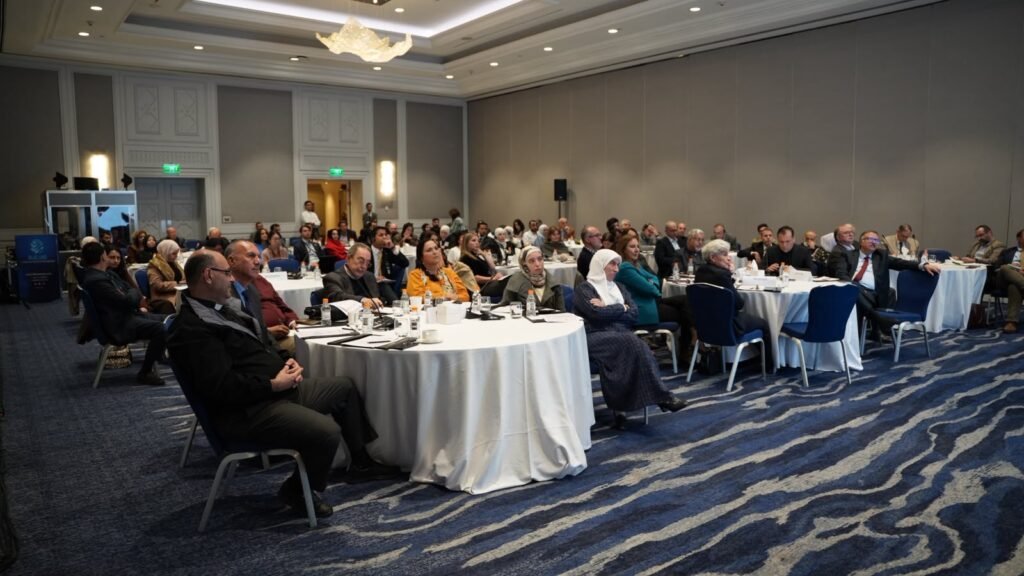
Amman, 9 November 2026 – The Palestine Strategy Group, in partnership with the Politics and Society Institute, launched a study examining how certain Christian theological visions are mobilized to support the Zionist project and its colonial and replacement-oriented aims in Palestine.
The launch of the study, “Toward a Palestinian Strategy to Confront Christian Zionism,” took place during a workshop held this morning in Amman. The study is based on a two-year research project and presents a Palestinian strategy that begins with mapping Christian Zionist networks in their national and local contexts, and extends to building long-term partnerships with churches, research and educational institutions, and decision-making circles in the West and the region in order to consolidate Palestinian rights.
According to Dr. A’zer Dakwar, a co-researcher in the preparation of the study, the report traces the path taken by some religious interpretations from church pulpits and the media to lobbying groups, electoral campaigns, and parliaments. In some cases, religious discourse helps present support for Israel as a moral or religious obligation. When this discourse is adopted by institutions capable of mobilizing voters and reaching officials, it can become a factor in shaping positions on issues such as Jerusalem, settlement, and diplomatic recognition.
According to Dakwar, the report distinguishes among three currents that overlap in some of their political positions, while differing in their religious premises. The first reads the establishment of Israel and its developments in light of end-times prophecies. The second links support for it to the idea of blessing and prosperity. The third proceeds from the belief in the continuation of the divine covenant with the Jewish people. This distinction, according to the report, helps in understanding the different motives behind political support for Israel, and also explains the diversity of positions within churches and evangelical currents themselves.
The cases addressed by the report offer different images of this influence. In the United States, which is the most prominent contemporary case in the study, advocacy networks operate through organized lobbying groups, partisan ties, and channels of access to foreign policy-making circles. In Brazil, they intersect with the electoral mobilization of some evangelical currents, and their impact appears in parliamentary and presidential debates, alongside diplomatic and economic considerations that affect the official position.
In Nigeria, the report traces the role of pilgrimage networks and relations among religious leaders in strengthening ties with Israel, in a context characterized by religious diversity and domestic political calculations. In South Korea, the impact of some of these networks appears more clearly in the mobilization of conservative Christian currents and in nationalist discourse, while it is difficult to trace a similar direct impact on official foreign policy. The study relies on these differences in proposing responses that take into account the nature of the actors and institutions in each country.
The report examines the impact of these discourses on the way Palestinian rights are presented in international debate. When Israeli claims related to land and sovereignty are presented as an extension of a religious promise, Palestinians may appear in the debate primarily as civilians in need of protection, or as refugees in need of assistance. In such a case, issues of self-determination, return, and sovereignty—issues connected to Palestinians’ collective rights—may recede.
The report raises a question that goes beyond the effect of these networks on any particular governmental decision. Does their influence change the way governments and religious institutions view Palestinian rights in the first place? The study treats this possibility in countries of the Global South as a question requiring further research, in light of the varying influence of these networks and the continued support for Palestinians’ right to self-determination in a number of those countries.
The report places Palestinian Christians at the heart of the proposed strategy, as an authentic part of the Palestinian people and as researchers, theologians, and actors in the global ecclesiastical debate. It links this role to providing them with space to present readings that proceed from their experience and history, and that address issues of land, belonging, and justice within churches and theological institutes.
The study proposes the establishment of an observatory to track organizations, media outlets, funding bodies, pilgrimage networks, and their links to political actors. Among its proposed tasks is studying cases in which religious support turns into a political impact that can be observed, such as the adoption of positions on Jerusalem, support for settlement policies, or influence on the debate over diplomatic recognition of the inalienable Palestinian rights.
At a later stage, the report proposes developing an intellectual and theological platform led by Palestinian and Arab Christians, producing research and educational materials in several languages and supporting exchange among researchers and clergy. It also calls for building sustained relationships with churches, theological institutes, and youth institutions, and for developing pilgrimage routes that allow visitors to become acquainted with Palestinian churches and communities and their contemporary history.
The report proposes measuring the impact of this work through changes that can be monitored, such as the presence of Palestinian history in theological curricula, the inclusion of Palestinian churches and communities in pilgrimage programs, and the extent to which this knowledge is reflected in the positions of church institutions on Palestinian rights.
The subject of the study intersects with the work of the Politics and Society Institute through the Adnan Abu Odeh Program for the Study of the Zionist movement and Israel, “AIN.” According to Rana al-Zagha, the project coordinator, the program qualifies young Jordanian male and female researchers to study the roots of the Zionist movement and analyze Israeli institutions and policies by referring to original sources, including Hebrew sources, and to prepare studies and policy papers addressing the repercussions of these transformations for Palestine, Jordan, and the region.
The partnership with the Palestine Strategy Group brings together two angles of research. The AIN Program follows how policies are formed inside Israel, while the Group’s study examines how these policies acquire support outside it and the effect of that on Palestinian rights. This cooperation makes it possible to place research on Israeli policies in dialogue with Palestinian studies that trace networks of support and influence in different countries.
The workshop program was divided into two sessions. The first was devoted to presenting the study’s findings and discussing its political and strategic dimensions, with the participation of the report’s authors, Dr. A’zer Dakwar and Dr. Xavier Abu Eid, and former Jordanian Foreign Minister Dr. Marwan Muasher. The second, with the participation of Dr. Fawzi Badawi and Reverend Dr. Munther Isaac, addressed the religious and theological roots of Christian Zionism and Palestinian and Arab Christian readings that criticize the use of sacred texts to justify occupation and settlement. The workshop concluded with interventions from the audience.