
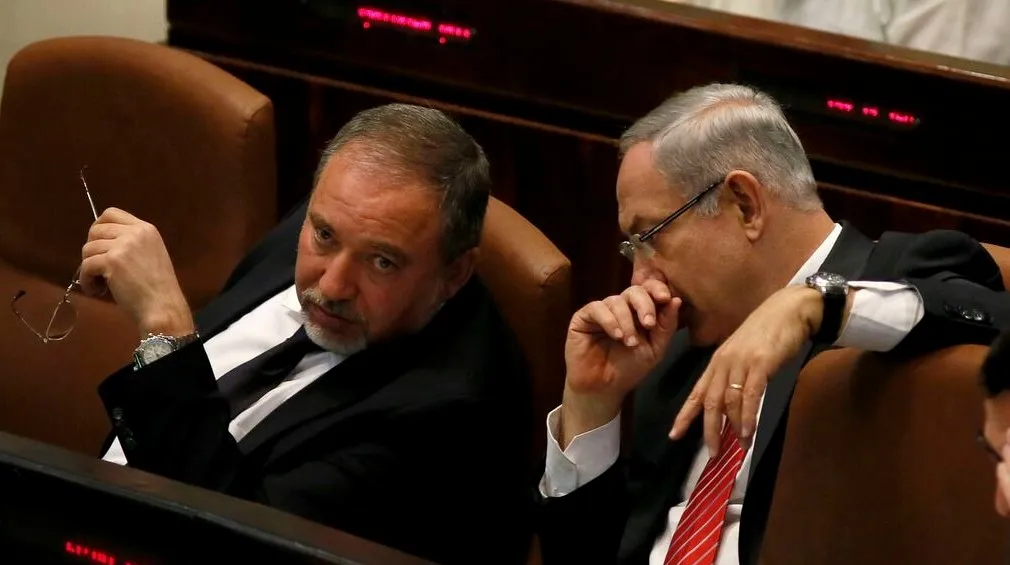
The proposal by the head of the “Yisrael Beiteinu | ישראל ביתנו” party, Avigdor Lieberman, to assign security and administrative responsibility in parts of The West Bank to Jordan sparked a dispute with Prime Minister Benjamin Netanyahu. In an interview with “בשבע | Besheva,” Lieberman argued that the Palestinian Authority is no longer capable of administering these areas, and that Israel must find an entity to assume responsibility for them. During the interview, he mentioned Areas B+C, before later clarifying that he meant A+B.1
Netanyahu attacked the proposal and described Lieberman as being from the left, demanding that he retract a proposal that could allow the Jordanian army to control what he called “the Land of Israel.” Lieberman responded by clarifying his conception: full Israeli control and geographic contiguity between parts of Area C, alongside assigning the administration of A+B to Jordan instead of the Palestinian Authority. He described the formula he proposes as an “Israeli-Jordanian confederation.”2
Netanyahu’s description of Lieberman as being from the “left” acquires additional significance in light of Israeli electoral competition. Netanyahu did not discuss the proposal merely as an arrangement for administering the West Bank; rather, he presented it as a concession of security control that right-wing voters should not accept. Lieberman responded by invoking the Bar-Ilan speech, in which Netanyahu had previously spoken about the possibility of establishing a Palestinian state, before he himself emphasized the need for Area “C” to remain under full Israeli control. Thus, the dispute acquired an electoral dimension, as the two sides competed to present their positions as the most committed to Israeli control over The West Bank, while the Palestinians’ right to determine its future remained outside the discussion.
If the discussion stopped at Netanyahu’s response, the disagreement would appear to concern the entry of Jordanian forces into The West Bank. But Lieberman’s clarification moves the question to another level: how can the administration of the population and control over the land be distributed during the coming stage? His proposal assigns Jordan responsibility for areas where most Palestinians live, while leaving Israel in control of the area that constitutes the largest part of The West Bank’s territory. Here, Jordan is no longer merely a proposed alternative to the Palestinian Authority; it becomes part of an arrangement that separates those who administer the Palestinians from those who hold decision-making power over the geography of their land. In the dispute over the two parties that would assume these roles, the Palestinians are absent as the rights-holders in determining the future of The West Bank.
Area “C” at the Heart of the Proposal
The division of The West Bank into Areas “A,” “B,” and “C” emerged within the transitional Oslo arrangements, which were supposed to lead to a permanent settlement3. But the continuation of the division has made the fate of these areas, especially Area “C,” directly influential in the future of any Palestinian state. Area “C” constitutes about 60% of The West Bank’s territory, and includes the settlements and expanses that separate and surround Palestinian communities4. Therefore, control over it cannot be viewed as an issue separate from the administration of Areas “A” and “B.”
The importance of this point appears in Lieberman’s own response. While he defended transferring responsibility for “A” and “B” to Jordan, he emphasized the need to create geographic contiguity between parts of Area “C” and to keep it under full Israeli control5. If the areas under Israeli control are linked in a way that entrenches this reality, then the question is no longer limited to which entity provides services or assumes security responsibility in Palestinian cities; it also extends to the ability of those cities to connect with one another and the possibility of establishing a Palestinian state on contiguous land.
In this sense, Lieberman’s proposal separates the population from the land. It seeks an entity to bear responsibility for administering Palestinians’ daily lives, but insists on Israel retaining control over a wide area of their land. Transferring administration may appear to be a change in the party responsible for the population’s affairs, but it does not answer the more important political question: what is the fate of the land on which Palestinians are supposed to exercise their right to self-determination? Indeed, focusing on the entity that administers them may obscure the continuation of control over the geography that determines their future.
The facts related to the land do not stop at the boundaries of Area “C.” The “Peace Now” movement has documented Israeli measures extending into Areas “A” and “B,” including infringement on the powers of the Palestinian Authority and pressure on its financial resources, alongside settlement activity in areas under its administration6. This does not mean that the Israeli government has adopted Lieberman’s proposal, nor that the declared disagreement between him and Netanyahu is merely formal. But it clarifies the context in which the proposal is being raised: the Authority’s powers are being eroded, Israeli measures affecting the land are expanding, and then a proposal appears calling for the administration of Palestinian areas to be assigned to another party. From here, the idea of “who administers the population and who controls the land” acquires its practical significance.
The Palestinian Authority and the Elections: Who Chooses the Administrative Authority?
Lieberman begins from a rejection of the Palestinian Authority’s continued administration of Areas “A” and “B,” and then proposes reaching an agreement with Jordan to replace it in security and administrative responsibility. This goes beyond criticizing the Authority’s performance or questioning its capacity to govern; it transfers a decision concerning the future of a Palestinian institution into an Israeli political discussion, without Palestinian will being its point of departure. The Authority can be criticized, reformed, or changed, but the question of who represents Palestinians and administers their affairs is not resolved by naming an alternative to it from outside them.
Lieberman’s proposal came days before the opening of candidacy registration for the Palestinian legislative elections on 26 September 2026, according to the timetable announced by the Central Elections Commission, with voting to be held on 28 November7. The proximity of the two dates does not prove that Lieberman intended to respond to the elections or influence them. Nevertheless, the simultaneity reveals a political paradox: at a time when a Palestinian electoral path is being put forward to reshape institutions and representation, the Israeli dispute raises a conception that bypasses the existing Palestinian institution and searches for an entity to administer Palestinian areas.
Elections, in and of themselves, do not resolve the problems of the Palestinian political system or the obstacles to holding them under occupation. But they reaffirm the principle absent from Lieberman’s proposal: the future of Palestinian institutions is a matter for Palestinians to decide. Replacing the Authority with an arrangement formulated outside this path is not merely an administrative adjustment; it affects the entity that exercises powers over Palestinians, and the position of Palestinians themselves in the decision concerning their future. This issue becomes more sensitive when the transfer of administration is coupled with maintaining Israeli control over Area “C.”
Jordan Between Responsibility for the Population and the Palestinians’ Right to the Land
Lieberman’s proposal assumes Jordan’s readiness to assume the responsibility he proposes transferring to it. In the interview, he said that Jordan “has no choice,” and spoke about the possibility of Jordanian forces entering or of forming forces under Jordanian command8. However, his statement does not present a declared understanding with Amman, nor can he define its role west of the river on its behalf. Moreover, for Jordan, the matter is broader than the question of accepting a security or administrative task; it is connected to the future of the Palestinian state, the nature of the relationship between the two banks, and the limits of the Jordanian role in an issue that, at its core, rests on the Palestinians’ right to their land.
One of the problematic aspects of the proposal lies in the fact that it transfers to Jordan the responsibility for administering Palestinians, while leaving Israel in control of Area “C.” If the entity that administers the population does not hold decision-making power over the largest area of The West Bank, then what is being proposed does not address the future of The West Bank as the land of a Palestinian state, but rather redistributes the burdens associated with its population. At that point, the Jordanian question becomes linked to the definition of the Palestinian issue itself: does it remain the cause of a people demanding sovereignty and self-determination, or does it become a question of administering a population whose responsibilities are shared by other parties?
The timing of the dispute acquires additional significance in this context. On 22 September 2026, King Abdullah II warned before the United Nations General Assembly against land seizure, settlement expansion, and the expulsion of Palestinians, and described what is happening in The West Bank as “de facto annexation” that seeks to make the establishment of a viable Palestinian state impossible9. The next day, Lieberman’s proposal emerged, suggesting that the administration of Areas “A” and “B” be assigned to Jordan while Israeli control over Area “C” is maintained. The proximity in timing does not indicate a direct link between the speech and the proposal, but it shows the difference in each point of departure: the future of the land and the state and the Palestinians’ right to self-determination in the Jordanian position, versus the distribution of responsibilities for administration and control in Lieberman’s proposal.
The Jordanian Ministry of Foreign Affairs had affirmed, in its condemnation of Israeli annexation measures, that Israel has no sovereignty over the occupied West Bank, and linked the settlement of the Palestinian issue to the Palestinian people’s right to self-determination and to the realization of their independent state on their land10. Therefore, a distinction should be made between Jordan’s support for the Palestinians and their state, and the assumption that it would replace their institutions in administering parts of The West Bank within an arrangement that preserves Israeli control over a large area of it. The former is a declared Jordanian position; the latter is an Israeli political proposal, and there is nothing to prove Jordan’s acceptance of it.
Who Decides the Future of The West Bank?
The Netanyahu-Lieberman dispute reveals a disagreement over the role that could be granted to Jordan in The West Bank, but it also reveals the limits of the Israeli discussion when it revolves around administering and controlling areas without beginning from the Palestinians’ right to self-determination. In Lieberman’s conception, responsibility for Palestinians in “A” and “B” is transferred to Jordan, while Area “C” remains under full Israeli control. As for Netanyahu’s objection, it targeted the possibility of the Jordanian army being present west of the river, and did not restore Palestinians to the position of decision-makers in the future of their land.
For this reason, the impact of the proposal is not measured by whether it is implementable tomorrow or whether Jordan will accept it; rather, it lies in what it reveals about the way the future of The West Bank is being conceived: the search for someone to administer the population, while control over the land continues to be treated as settled or expandable. Here lies the question absent from the dispute: will The West Bank continue to be discussed as the land of a people with a right to sovereignty and statehood, or will it gradually be reduced to areas whose administrative responsibility is distributed among other parties, while the future of its geography is decided without the Palestinians?