
Following this reading is the full Arabic translation of Tamir Hayman’s paper, “The ‘New’ National Security Concept: Concept Formation and Questions for Discussion,” along with Netanyahu’s document on Israeli national security. The translation preserves the original text’s structure while separating the author’s positions from the analysis presented here.
Ahmed Al-Qudah and Ali Hijazi
- The Israeli security doctrine is undergoing a transformation that goes beyond reviewing military tools to redefining the function of power, the boundaries of security, and its relationship with national identity—a shift crystallized in practice after October 7, 2023, before some of its principles were explicitly expressed in Netanyahu’s 2026 document.
- The center of gravity in Israeli security thinking shifts from managing threats and deterring adversaries to preventing the formation of potential dangers, through expanding offensive initiative and preventive operations, while deterrence and early warning remain core tools of national security.
- The concept of advanced defense redefines the relationship between borders and military power, as security assessments form the basis for extending the defensive sphere beyond recognized borders, potentially turning buffer zones into persistent sources of friction and escalation.
- Comparisons among Hayman, Netanyahu, and the National Security Studies Institute documents reveal disagreements within the Israeli security elite regarding sources of security and the limits of force use, particularly concerning the relationship between military superiority and political settlement, and between offensive initiative and regional stability.
- The Palestinian issue acquires a central position in Israeli security transformation, as diminished recognition of its national particularity and expanded settlement solidify a logic of territorial control and population management, while narrowing the available space for political settlement based on rights and sovereignty.
- Addressing the weakness of Arab states as a strategic opportunity involves a deep security paradox: regional disintegration may yield short-term military gains but generates more fragile environments, increases the likelihood of repeated interventions, and undermines prospects for building stable security arrangements.
- Including settlement, Jewish heritage, and identity within national security principles transcends symbolic and political functions, revealing an increasing intertwinement between national identity formation and defining the state’s military and geographic priorities.
- Israel’s pursuit of arms and technological independence raises a dilemma related to resource limits and sustainability, as raising military expenditure and expanding local capabilities require massive human and economic investments, even as Israel remains dependent on alliances and international networks.
- Israeli security transformations directly impact the strategic environment of Jordan, Palestine, Syria, and Lebanon, through the futures of the West Bank, buffer zones, regional sovereignty, and the potential widening gap between political agreements and security practices on the ground.
- The core dilemma of the emerging Israeli security doctrine is the potential for military superiority to shift from a means to achieve security to a source of strategic expansion difficult to control; as the territory Israel seeks to control in the name of security expands, so too do the obligations, threats, and conflicts it must manage.
In protracted wars, security doctrines sometimes change before states officially announce the change. Military decisions accumulate, the boundaries for force use expand, and exceptional measures imposed by extraordinary circumstances turn into stable rules in security management. When this transformation reaches a level that redefines the relationship between war and peace, borders and sovereignty, national identity and sources of power, the matter goes beyond revising military strategy. It concerns the very nature of the state itself and the image it seeks to impose on its regional environment.
This issue provides an entry point to read the paper published by Major General (ret.) Tamir Hayman, director of the Israeli National Security Studies Institute (INSS), on October 12, 2026, titled “The ‘New’ National Security Concept: Concept Formation and Questions for Discussion.” Hayman tries to identify the principles governing Israeli security practice since October 7, 2023, based on the premise that Israel is experiencing a transformation in the concept of national security, whose principles took shape through security practice before Netanyahu released his public vision on October 18, 2026.
The document “National Security Concept by Prime Minister Benjamin Netanyahu,” announced by Netanyahu’s office on October 18, 2026, nine days before the Knesset elections scheduled for October 27 of the same year, adds another level to this discussion. It lays out explicit principles allowing a comparison between the trends Hayman extrapolates from practice and Netanyahu’s orientations as a security concept update. The joint reading reveals convergence in the priority of prevention and offensive initiative and the expansion of defensive tools, with differences in the nature of the two texts and the limits of inferences drawn from them.
The importance of the paper stems from the institutional position of its author, who headed the Israeli military intelligence division “Aman” between 2018 and 2021, and from the nature of the debate it provokes within Israeli strategic thought. The paper addresses the change in the function of military power, the boundaries of Israel’s security realm, and the future relationship with the Palestinians, Arab states, and the United States, reaching the fundamental question posed by Hayman: What kind of state does Israel want to be after October 7?
The Institute and the Context of Israeli Security Discourse
The National Security Studies Institute was established in its current form in 2006, as an extension of the Strategic Studies Center founded by Tel Aviv University in 1978, following the October 1973 war and the intelligence failures and assumptions that led the Israeli security establishment to consider reform. The center later became known as the Yaffeh Center for Strategic Studies, before transforming into the National Security Studies Institute. It functions as an independent research institution with a policy-oriented approach, combining academic research with military, intelligence, and diplomatic expertise, seeking to influence debates and decisions related to Israeli national security.
This origin merits pause; the center originally appeared in response to a crisis in security concepts after the 1973 war, and today, it faces similar questions after the October 7, 2023 failure. In both cases, the relationship between intelligence assumptions, military doctrine, and political decision-making is central. The current debate broadens to include the nature of the state and its identity, and the limits of war as a means of achieving security.
Hayman’s paper gains additional significance when read in the context of evolving strategic debate within the institute itself, which in March 2025 issued a document on national security doctrine and policy trends for 2025–2026, to which Hayman contributed. That document presented a conception combining military power, regional and international partnerships, maintaining recognized borders, and enhancing the Jewish and democratic character of the state. In August 2026, researcher Ofer Shelah, responsible for the institute’s national security policy program, published a critical study of the new security strategy’s logic and the continuous war and economic, military, and political burdens it might impose.
Within this context, Hayman’s paper is an attempt to crystallize the ongoing transformation and subject it to discussion. The sequence of these texts reveals intellectual disagreements within Israeli security research circles about the sources of security and the limits of force use, and about the relationship between military supremacy and political stability.
From Threat Management to Prevention of Threat Formation
Hayman’s reading is based on ten principles he extracts from current Israeli practice, including the priority of Jewish identity over democratic considerations, treating peace as a temporary means, viewing the weakness of Arab states as a securable condition, adopting perpetual war and offensive initiative, expanding advanced defense and settlement, and seeking greater strategic and industrial independence from the United States.
The author stresses that these principles represent a deliberately exaggerated theoretical formulation meant to reveal the possible logic underlying security policies and spark discussion. Thus, reading the paper requires distinguishing between the assumed doctrine Hayman reconstructs, his critical stance toward its outcomes, and the actual policies subject to analysis and verification.
We believe the most significant shift is moving the center of gravity from managing threats to attempting to prevent their emergence altogether. Traditional Israeli security thinking relied on deterrence, early warning, and decisive military action, using preventive and preemptive operations only in specific conditions. The conception Hayman discusses expands military intervention to include capabilities that may in the future become threats and grants ongoing priority to offensive initiative over awaiting threat development or containment.
The strategic implications of this shift go beyond the size of the force used to when and under what standards force is employed. Deterrence affects the adversary’s calculations to avoid certain behavior, whereas the preventive logic broadens force use to emerging threats, assigning growing weight to assessments of future capabilities in military decision-making. In the absence of clear criteria for defining the nature and degree of threat realization, this expansion might target capabilities not yet crystallized as imminent dangers. With the threat definition extending to future potentials, temporal boundaries of military operations become more ambiguous, and the likelihood of operations repeating increases, especially as weakening existing capacity may lead to alternate capabilities emerging, causing attempts to prevent rebuilding to trigger new rounds of force use.
The criterion for security success itself changes here. In the conception prioritizing deterrence and stability, it relates to a state’s ability to reduce war outbreak probabilities and prolong calm periods. When removing potential threats becomes a permanent goal, repeated operational achievements may coexist with ongoing conflict expansion. The question concerning the relationship between military superiority and political outcome becomes more urgent: Does destroying adversaries’ military capabilities produce a more stable regional system, or reshape threats in new forms requiring successive interventions?
Netanyahu’s document gives direct expression to this shift by prioritizing threat prevention and offense over containment and defense, including preventive strikes to thwart emerging threats. Yet it maintains deterrence and early warning as fundamental principles; thus, the change concerns the arrangement of tools and offensive initiative’s centrality, not the disappearance of traditional concept elements.
From Border Defense to Expanding the Security Sphere
The second transformation manifests in redefining the security geography. Hayman discusses the concept of “advanced defense,” which relies on establishing security areas beyond borders, transferring confrontation onto adversaries’ lands, and employing military deployment, settlement, and civilian communities within the defense system. These areas include the Gaza Strip, southern Lebanon, Syrian territories, in addition to the West Bank.
The danger in this conception is turning the security field into a moving space, defined according to threat assessments and military operational needs. This approach rephrases the relationship between borders and force, as security evaluations serve as the basis for determining the scope of military deployment and the areas Israel seeks to control or maintain a military presence in, thereby giving the security sphere a fluctuating character that transcends recognized borders.
This logic contains a strategic contradiction requiring scrutiny: as areas deemed necessary to Israel’s security expand, so do the spaces needing protection and clash points with local populations, forces, and neighboring states. This process may generate additional security needs, which in turn justify further military deployment. Consequently, advanced defense, if entrenched, becomes a cycle of recurring security expansion, where attempts to reduce risks generate new sources of friction and escalation.
This challenge intensifies when settlement and civilian aggregation are included in defense calculations, as civilian presence in conflict zones imposes ongoing security obligations and complicates the separation between military functions and political and demographic considerations. The discussion thus shifts from border protection to defining the nature of lands included within Israeli political and security spheres.
In the document, this intersection appears in the defense principle, which combines repelling invasion at the borders and creating buffer zones “as necessary.” The significance of this phrase lies in incorporating buffer deployment into declared defense tools without specifying its geographic scope, duration, or conditions for termination. Questions about who determines necessity and criteria for ending it become part of the assessment of this conception.
The Palestinian Issue and Arab States in Security Conception
One of the paper’s most sensitive principles extends beyond military action to the political basis of the conflict. Hayman presents a conception that denies the authenticity of the Palestinian national movement, reinterpreting the Palestinian issue as an extension of a continuous Arab struggle against Israel. Under this view, the possibility of a separate Palestinian state conflicts with the concept of security, while expanded settlement and limited local governance for Palestinians are proposed as alternatives for managing the existing reality.
The significance of this shift lies in redefining the subject of the conflict itself. When Palestinians are redefined as part of a continuous Arab dispute and their independent national identity diminishes, political settlement loses its status as a potential framework to end the conflict. Conversely, when the Palestinian issue is treated as a national and political matter, options relating to rights, sovereignty, borders, and settlement remain part of strategic discussion, even amid deep disagreements.
This point requires a fundamental differentiation: Hayman reviews this conception as one possible principle of the new doctrine and places it within a critical framework. The broader analytical significance is that introducing denial of Palestinian national identity into a national security conception makes territorial control and population management possible alternatives to political settlement, opening the door to prolonged struggle over sovereignty, rights, and legitimacy.
Hayman presents another highly significant principle based on viewing Arab states as weak or artificial constructs lacking cohesive national foundations, making their disintegration or sustained weakness conditions Israel could exploit strategically. The danger of this idea is that it redefines the relationship with the regional environment on the basis of preferring weakness of neighboring states over their stability.
This logic assumes that dealing with fragmented entities or divided societies provides Israel a wider scope for military and political maneuvering compared to dealing with stable states possessing strong institutions and coherent sovereign decision-making. However, this assumption conflicts with the nature of threats that usually arise in fragile environments, where smuggling networks and armed groups proliferate, centers of power multiply, and governments’ ability to enforce security arrangements and political commitments declines.
A key strategic paradox arises here: neighboring state weakness may yield short-term tactical gains but limits any party’s capacity to build stable security arrangements with it. A state losing effective control over its territory cannot guarantee borders, control armed actors, or enforce agreements, making external military intervention more frequent and costly.
Thus, if preferring Arab state weakness becomes an established security norm, it might produce the environment Israel uses to justify ongoing interventions. This also contradicts some parts of the Israeli strategic establishment envisioning the importance of cooperation with stable Arab states and building regional security and economic partnerships.
This absence gains extra significance when compared to the inclusion of settlement among principles related to national identity and internal cohesion, revealing a paradox: the prominence of land in the symbolic and security conception of the state contrasts with the limited space devoted to addressing Palestinians’ political and national rights. This question is reinforced when comparing Netanyahu’s document with the institute’s 2025 conception, which more explicitly positioned political and geographic separation between Israelis and Palestinians within the national security future debate.
Comparison with the 2025 National Security Studies Institute document exposes a deeper divergence regarding the Palestinian issue’s place within Israeli security calculations. Although the document expresses skepticism about reaching a final settlement in the near term, it calls for steps toward political, geographic, and demographic separation between Israelis and Palestinians, warning that settlement expansion deep into Palestinian lands pushes toward a one-state reality with effects on Israel’s Jewish and democratic identity. It links Israel’s security to maintaining recognized borders, enhancing existing peace agreements, and regional partnerships. Conversely, Netanyahu’s document prioritizes military initiative and buffer zones in the security conception, incorporates settlement into identity and national cohesion elements, yet lacks detailed political treatment of the Palestinian issue’s future. This contrast reveals differing views of the relationship between security and sovereignty; the institute’s document assigns political settlement and geographic separation roles in long-term security, while Netanyahu’s focuses on military superiority and threat prevention, leaving the relationship between these tools and the political settlement’s future open to interpretation.
National Identity and the Limits of Force
The linkage between security doctrine and national identity is the paper’s central intellectual addition. Hayman distinguishes three interconnected levels: national identity defining the state’s nature and values; the national security concept translating this identity into relatively stable strategic principles; and security policies governments implement according to their political and ideological choices.
Based on this distinction, Hayman argues that the profound change in the security concept may reveal a broader change in Israeli identity itself, especially in prioritizing Jewish identity over democracy and equality, and transforming war from an exceptional situation into a permanent aspect of state existence.
This idea allows a more nuanced reading of the relationship between security and domestic politics. The security doctrine shapes the nature of threats the state prepares to face, influences resource allocation, the military’s status, limits on executive power, and the state-citizen relationship. When military mobilization is continuous, security considerations increasingly affect public debate, civil institutions, and economic priorities.
However, a necessary historical note is that Hayman’s comparison between traditional and emerging doctrine overlooks that Israel’s past experience included extensive preventive and preemptive force use, military intervention outside borders, occupation, and settlement policies. These practices appeared at various stages, culminating in the 1982 Lebanon War and subsequent military operations. Thus, key elements of the doctrine Hayman discusses have long-standing roots in Israeli strategic history.
More precisely, the current shift is best analyzed as changes in the centrality, extent, and political and ideological justification of these tools. Earlier practices provided precedents for force use and control expansion; the current phase’s importance lies in potentially elevating some practices to the governing principles of the national security concept.
This distinction between continuity and change is crucial, preventing the issue’s reduction to October 7 alone, and allowing understanding of the relationship between decades-long security policy accumulation and the shock that justified expanding their use.
The connection between identity and security appears in Netanyahu’s “spirit of the people” clause, which combines the nation-state of the Jewish people, democratic governance, readiness to fight, settlement, and heritage. This combination calls for questioning how these elements are prioritized when conflicting, but alone does not prove the document subordinates democracy to Jewish identity. Likewise, including settlement among cohesion and identity components assigns it functions beyond direct military calculations, without specifying its geographic extent.
The implication of this linkage is that national identity becomes a source for setting security priorities, granting land, settlement, and heritage issues a place beyond cultural symbolism, creating overlap between national identity formation and military objectives, especially when land control is seen as part of national security building.
Strategic Independence and Resource Limitations
The paper also addresses the trend toward reducing dependence on the United States and enhancing industrial, military, and technological independence. This orientation reflects, in Hayman’s account, a conviction that close ties to major powers may impose political and operational constraints on Israel’s freedom to use force, and that building independent local capacities is a guarantee for sustaining military superiority.
The economic and social dimensions of this shift appear in Ofer Shelah’s August 2026 study, criticizing what he terms the “Great Sparta” strategy and warning that perpetual war, expanding security zones, and growing dependence on local military production may impose burdens beyond Israel’s economic and social capacity to bear. Shelah connects ongoing military operations with reserve force depletion, economic disruption, and social cohesion weakening, based on economic assessments showing tension between rising defense spending and growth demands. In contrast, Netanyahu’s document prioritizes expanding the defense budget, strengthening military manufacturing, and technological independence as necessary to maintain superiority and prevent threats. This contrasts in estimating the relation between resources and security goals: Netanyahu treats capacity expansion as a condition to enhance security, while Shelah questions the economy’s and society’s ability to finance and sustain these capabilities. The dilemma lies in the possibility that pursuing maximum military power may drain the economic and human foundations underlying military superiority itself.
A paradox emerges concerning Israeli power’s nature: the wider its military and geographic commitments become, the more it needs external resources and partnerships, even as the new conception pushes to reduce dependence on those partnerships. This contradiction may widen the gap between security objectives and available resources, especially if recurrent confrontations become prolonged.
Another difference emerges comparing the role of external alliances in different security conceptions. The 2025 institute document regarded the special strategic relationship with the United States as among Israel’s foremost strengths, linking national security with integration into the global economy, maintaining international support, and fostering security and political cooperation with Arab states. Netanyahu’s document gives increasing priority to independence in weapons production and advanced technologies, while continuing to emphasize the importance of regional and international alliances. The difference thus lies in estimating an acceptable degree of external dependence and the nature of resources to secure locally. The paradox is that reducing external military dependence requires technological and industrial investments that themselves rely on extensive networks of funding, knowledge, and international trade. Expanding military independence might therefore increase the need for some forms of reciprocal economic and technological dependence, making full independence more complex than merely localizing defense industries.
Netanyahu’s Document and the Transition to Political Declaration
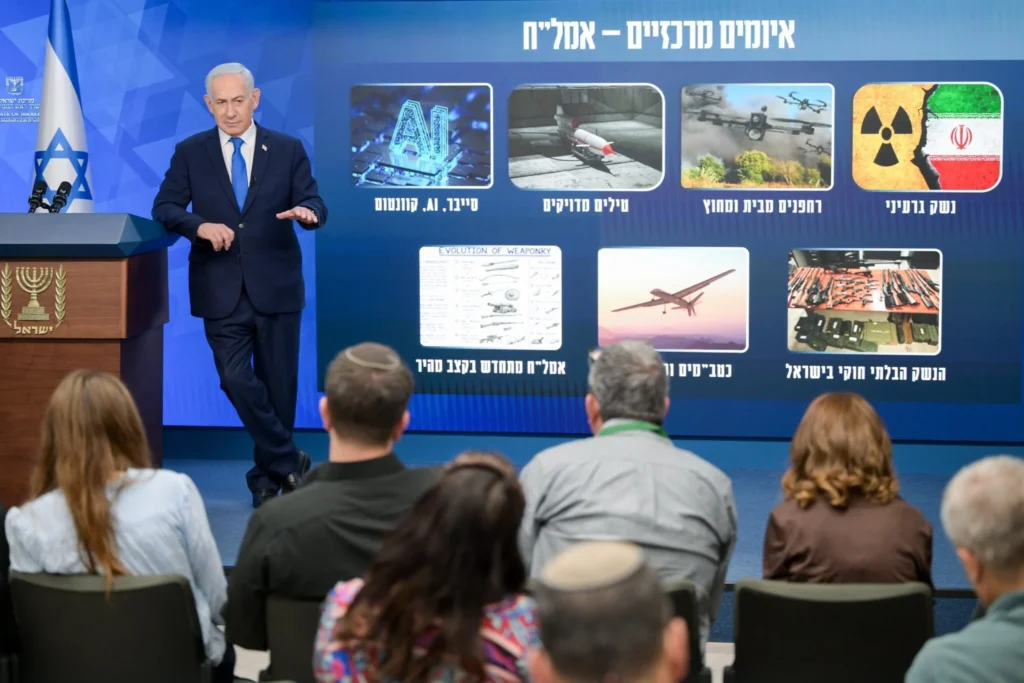
Besides the aforementioned intersections, Netanyahu’s document provides a political narrative of the war’s outcomes, attributing to Israel the elimination of a nuclear annihilation threat and dismantling the Iranian envelope. This narrative functions to justify updating the security conception: the military achievement the government claims serves as the basis for adopting new principles. Thus, analysis must separate the role these claims play in the text from verifying their truth or the persistence of the results they describe.
The definition of victory reveals a central aspect of this construction, tied to breaking the enemy’s strength and confidence in its ability to constitute an actual threat. This definition specifies the required outcome in adversaries’ capabilities and will but does not detail the nature of political arrangements following fighting. Here, the document’s analysis converges with Hayman’s question: what turns military achievement into a political situation that reduces the need to repeat war?
The document adds “the struggle over consciousness” to security tools, utilizing artificial intelligence and confronting international anti-Zionism and anti-Semitism. This indicates an expansion of the confrontation sphere to include perceptions, legitimacy, and international image. However, conflating anti-Zionism and anti-Semitism in a single clause does not erase the distinction between critique of a political project and hatred of Jews; analyzing this clause requires examining how this conflation is employed in responding to external criticism of Israeli policies.
From Public Text to Institutional Doctrine
Hayman’s paper makes an important contribution by revealing the tension between the logic of military security and the components of broader national security. Its strength lies in showing that military choices carry political and ideological assumptions and that changes in the tools of force use may be linked to changes in the state’s self-conception and regional role.
Netanyahu’s document narrows the gap between deducing principles from practice and the existence of an explicit political text but does not resolve the degree of institutional adoption. Demonstrating stable change in the security concept requires following how principles reflect on military planning, resource allocation, and decision-making, distinguishing between declaring orientations and adopting executive rules to regulate them.
The importance of this test arises when goals compete for resources or conflict in application. Constant readiness, increased local production, and technological superiority demand expenditure and human capabilities, while expanding military freedom might pressure the alliances the document seeks to strengthen. The list of principles alone does not specify priorities or mechanisms for resolving such trade-offs.
Another critical angle pertains to the framework Hayman chooses, focusing primarily on risks the new doctrine may pose to Israel’s future, its democratic identity, economy, and foreign relations. The implications of this doctrine for Palestinians and Arab states appear within the discussion, but analysis from the perspectives of sovereignty, rights, and regional stability still requires broadening. From a regional standpoint, the issue goes beyond Israel’s costs to its effects on societies within the sphere it seeks to subject to its security considerations.
This highlights the need to separate two connected questions: the new doctrine’s capacity to produce security for Israel and its impact on generating insecurity for neighboring states and societies. Some military actions might effectively reduce immediate threats, while their long-term political and geographic repercussions weaken regional stability. The relationship between these levels needs evaluation beyond operational calculations to extended strategic outcomes.
Jordanian and Regional Implications
The security conception that denies the specificity of the Palestinian national issue and redefines it within a continuous Arab-Israeli conflict broadens political and regional confrontation dimensions: continued control over Palestinian lands and rejection of an independent state becomes a source of tension with Arab states and challenges existing relations with Israel, especially amid settlement expansion and undermining political settlement possibilities. Jordan is prominent here due to the connection between its national security, political stability, demographic balances, the Palestinian issue’s prospects, and the future of the West Bank. Egypt and regional relations’ capacity to persist amid widening gaps between political agreements and security practices on the ground are also relevant.
For Syria and Lebanon specifically, this challenge becomes clearer due to the link between their security files and sovereignty, state monopoly on arms, and institution rebuilding issues. Any Israeli security conception based on maintaining spheres of influence or imposing long-term unilateral arrangements could deepen difficulties in building a stable security regime along borders. This impact increases where military interventions overlap with internal competition and the multiplicity of local and regional actors.